
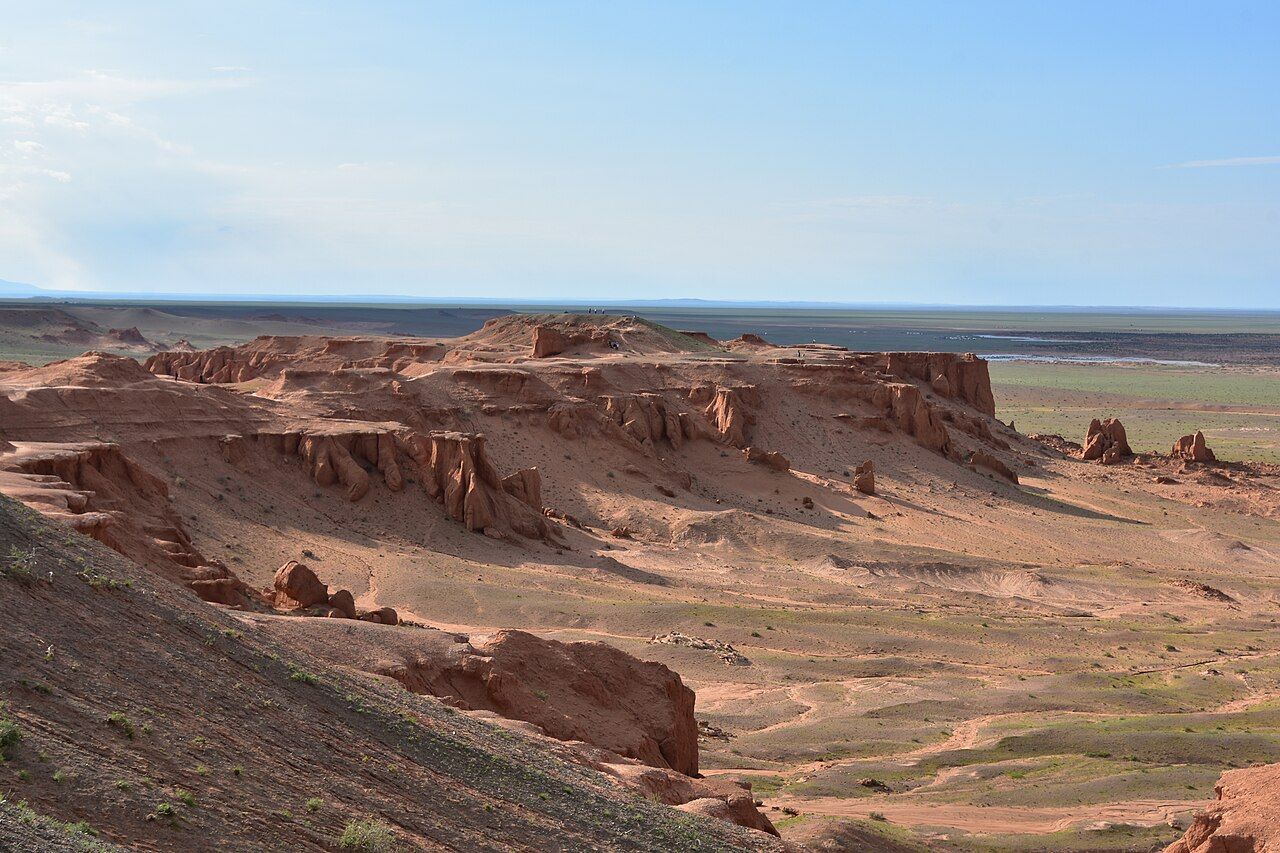
In the south of Mongolia, in the province of Ömnögovi, a line of red and orange sandstone cliffs rises from the gravel plains of the Gobi. Mongolians call the place Bayanzag, after the saxaul shrubs that grow there. The rest of the world knows it as the Flaming Cliffs, a name given by the American explorer Roy Chapman Andrews, who watched the rock glow in the evening light.
It is one of the most famous fossil sites on Earth. Few dinosaur sites are better known by name, and few are as remote. Getting here takes planning, but standing on the rim at sunset, looking down at the gullies where some of the best-known small dinosaurs were found, is worth the long road.
Roy Chapman Andrews and the 1923 eggs
In the 1920s the American Museum of Natural History in New York sent a series of large expeditions into the Gobi, led by Andrews. They travelled with cars and camel caravans, and their aim at first was to look for early human ancestors in Central Asia. They did not find those. They found dinosaurs instead.
At Bayanzag the expedition found many skeletons of a small horned dinosaur, Protoceratops. In 1923 a member of the team found something even more striking: fossil eggs, laid in clutches. They were the first dinosaur eggs to be recognized as such by scientists, and the news made the expedition famous around the world. Many of these finds now sit in the fossil halls in New York.
At first the eggs were thought to belong to Protoceratops, the most common dinosaur at the site. A small, toothless dinosaur found near one nest was named Oviraptor, meaning egg thief, because it seemed to have died raiding the nest. Decades later, embryos found inside similar eggs showed that the eggs belonged to Oviraptor's own family. The supposed thief was probably a parent sitting on its nest.
Protoceratops and Velociraptor
The real Velociraptor was also named from fossils found on these expeditions. Forget the film version. It was about the size of a large dog, with a long, low snout, a large curved claw on each foot and, as later finds of related animals show, feathers. It hunted in the same dry, dune-covered landscape as Protoceratops.
The two are linked by one of the most famous fossils ever found. In 1971 a Polish and Mongolian expedition working at another Gobi site found a Velociraptor and a Protoceratops locked together, apparently killed in mid-fight, probably by a collapsing sand dune or a sandstorm. The fossil is a national treasure in Mongolia and is kept in the capital.
The rocks at Bayanzag are Late Cretaceous, roughly 75 million years old. They formed in a dry landscape of sand dunes and oases, which is why so many animals were buried whole and quickly. Compare it with the river-plain country of Hell Creek, a few million years younger and a world away in setting.
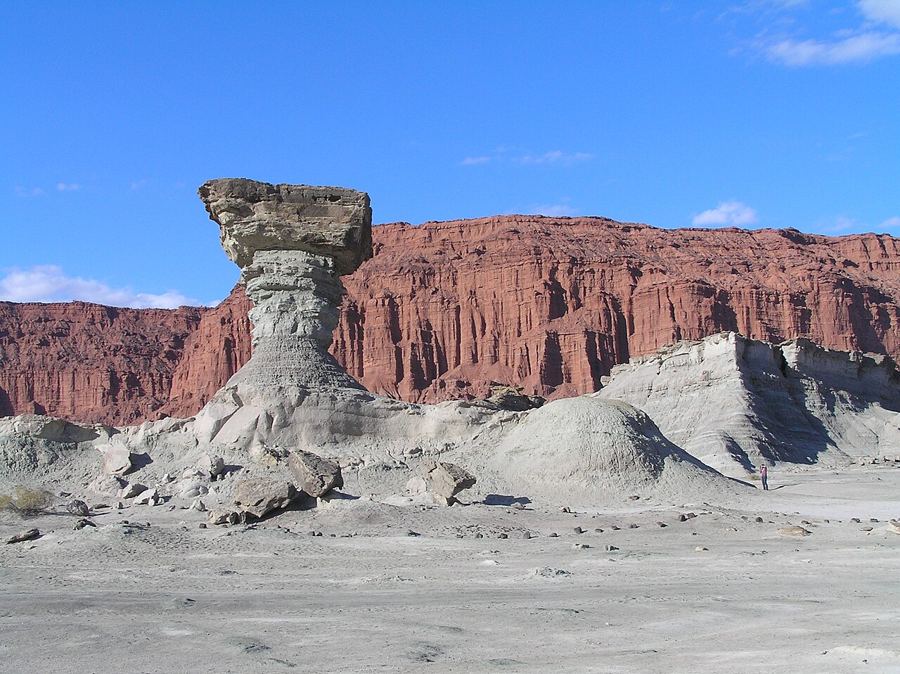 Another trek · AbroadIschigualasto, the Valley of the Moon
Visiting the cliffs
Bayanzag lies a few hours' drive from Dalanzadgad, the provincial centre. Most visitors arrive as part of a wider trip through the southern Gobi, travelling with a driver and a guide in a sturdy four-wheel-drive vehicle. Roads are often unpaved tracks, and distances that look short on the map can take most of a day.
At the site there is a viewpoint along the rim and paths down into the gullies. The rock is soft and crumbly; stay on worn routes and keep back from the edges. Late afternoon and sunset bring out the colour the cliffs are named for.
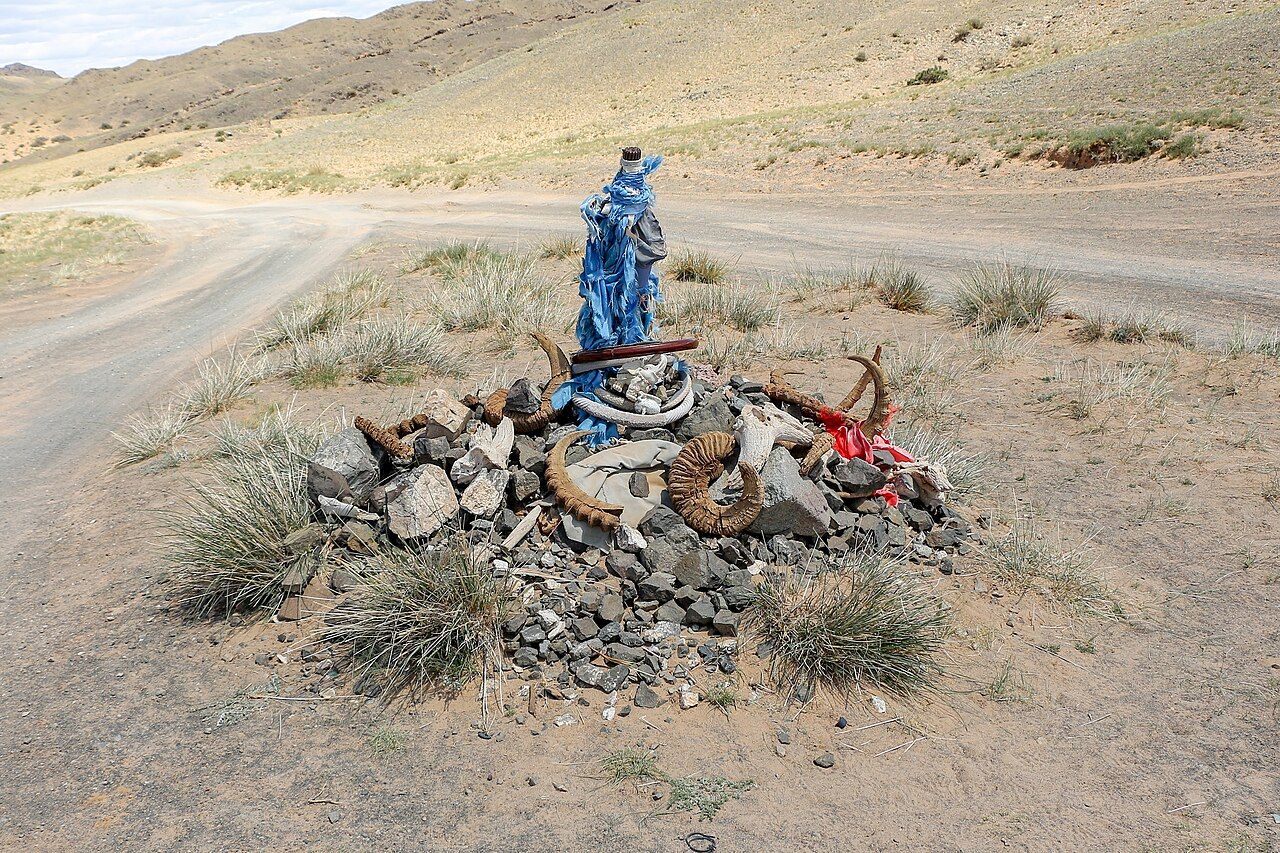
You will pass ovoo, stone cairns hung with blue silk scarves, along the roads. Many Mongolians walk around them clockwise and add a stone for a safe journey. Follow your guide's lead and treat them with respect.
Fossils and the law
Mongolia protects its fossils. Collecting them without permission and taking them out of the country are illegal. In recent years Mongolia has worked with other governments to bring home skeletons that were smuggled out and offered for sale abroad. Never buy a fossil offered to you in Mongolia, and never pick one up at the cliffs.
If you see bone weathering out of the rock, take a photograph, note the spot and tell your guide. That is the same advice that holds almost everywhere; the details are in finding fossils without breaking the rules.
Travel in the Gobi in general
The Gobi is a cold desert. Summers can be hot by day and cool at night, and winters are long and bitterly cold. Wind and dust are common in spring. Most visitors come between June and September, when the weather is most settled, though storms still happen.
- Getting there: fly or drive from Ulaanbaatar to Dalanzadgad, then continue by road.
- Staying: most visitors sleep in ger camps, felt tents set up for travellers, or camp with their guide.
- Health: carry more water than you think you need, sun protection and a basic medical kit; help can be far away.
- Paperwork: entry rules for Mongolia change, so check visa and travel requirements well before you go.
Many trips combine the cliffs with the nearby Gobi Gurvansaikhan National Park, with its sand dunes and narrow ice-filled gorge. A week in the south shows you the desert as the expeditions saw it: wide, quiet and full of stories still waiting in the rock.
The photographs on this trek were shared under open licences; their photographers are named in Who shot the bones.