
Drumheller sits deep in the valley of the Red Deer River in central Alberta, a town with a coal-mining past laid out among bare, banded badlands. A short drive from the prairie above, the land falls away into canyons and hoodoos, and on the edge of town stands the Royal Tyrrell Museum of Palaeontology, one of the largest dinosaur museums in the world.
Together they make one of the easiest dinosaur trips in North America. You can spend a morning among skeletons, an afternoon on the trails among the rocks where fossils come from, and an evening watching the low sun turn the valley walls gold. Drumheller is roughly a 90-minute drive northeast of Calgary.
Inside the Royal Tyrrell Museum
The museum opened in 1985 and is run by the province of Alberta as a research institution as well as a public one. Its main dinosaur hall holds dozens of mounted skeletons, many of them from Alberta: tyrannosaurs, horned dinosaurs, duck-bills and armored dinosaurs set out in scenes of the worlds they lived in. Windows let you watch technicians in the preparation lab freeing bones from rock.
Some of the most striking specimens surprise people. A nodosaur, an armored dinosaur found in an oil sands mine in northern Alberta, is preserved in three dimensions with its armor and traces of skin still in place, so it looks more like a sleeping animal than a skeleton. Other galleries cover the early history of life, the Burgess Shale animals of the Rockies, marine reptiles from Alberta's ancient seas, and the Ice Age mammals that came long after the dinosaurs.
Take time with the smaller displays too. Cases of teeth, eggshell, footprints and plant fossils fill in the world around the big skeletons, and the labels explain how researchers work out the age of a rock layer or the diet of an animal from the wear on its teeth. Children often find the tiny fossils, such as small teeth and fish scales, as exciting as the giants.
Entry is charged, and the museum offers programs for families, some of which take visitors into the field with staff. Hours, prices and programs change by season, so check before you go.
The Albertosaurus bonebed
The museum is named after Joseph Burr Tyrrell, a geologist who in 1884 found a dinosaur skull in the valley near here. It was later named Albertosaurus, after the province, and it became one of the region's signature predators, an earlier, lighter relative of Tyrannosaurus rex.
In 1910 Barnum Brown, working for the American Museum of Natural History, found a quarry upstream on the Red Deer River holding the bones of several Albertosaurus. He shipped some of them to New York, and the site was then largely forgotten. In the late 1990s, researchers from the Royal Tyrrell relocated the quarry, now inside Dry Island Buffalo Jump Provincial Park, using Brown's old photographs, and began digging again. They found the remains of at least a dozen individuals, young and old, buried together.
A bonebed of so many tyrannosaurs of one kind raised a question that still excites researchers: did these predators sometimes live and hunt in groups? The bonebed alone cannot prove it, since carcasses can gather in one place for other reasons, but it remains one of the classic puzzles of Alberta palaeontology.
A bonebed of so many tyrannosaurs of one kind raised a question that still excites researchers: did these predators sometimes live and hunt in groups?
The Hoodoos and Horseshoe Canyon
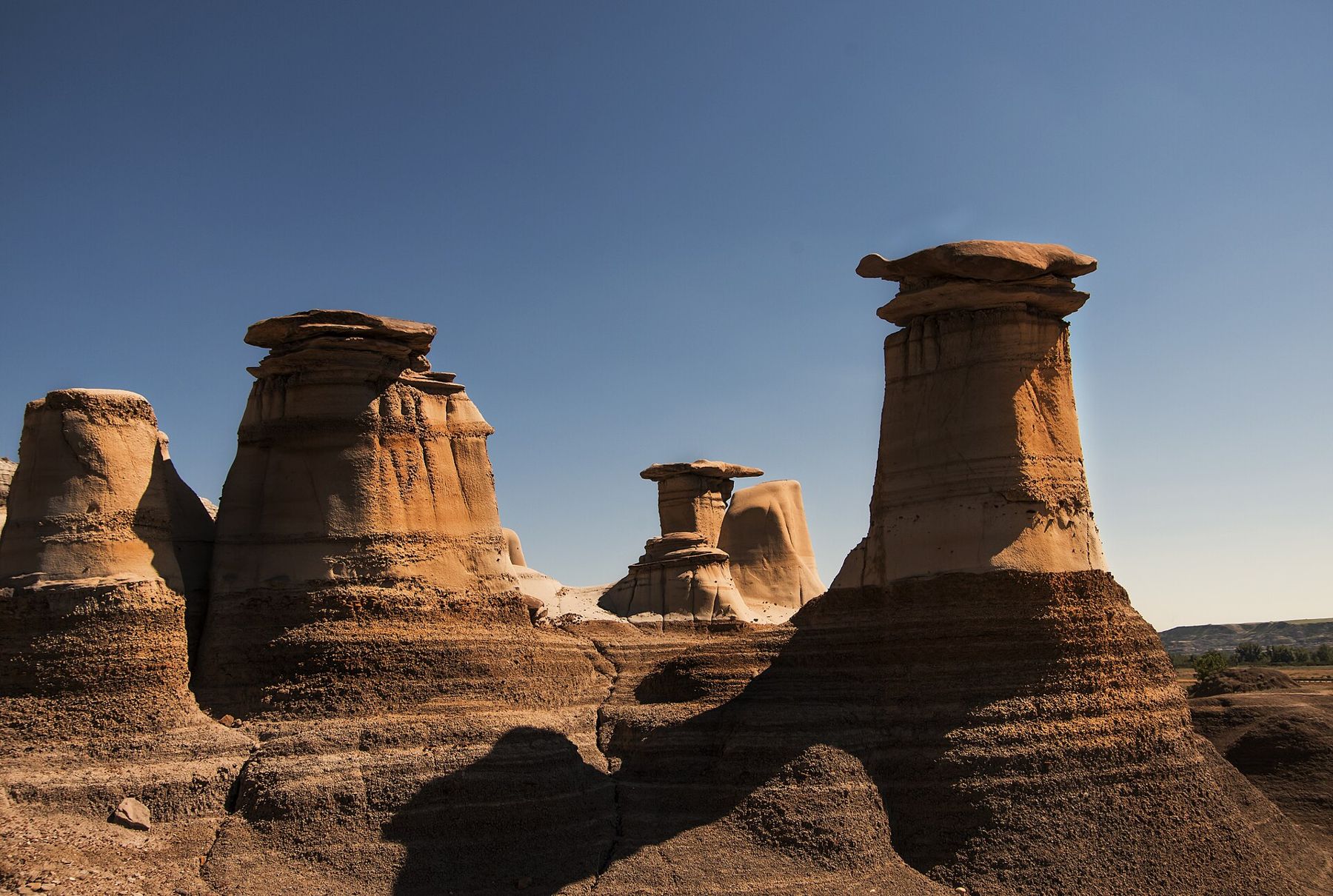
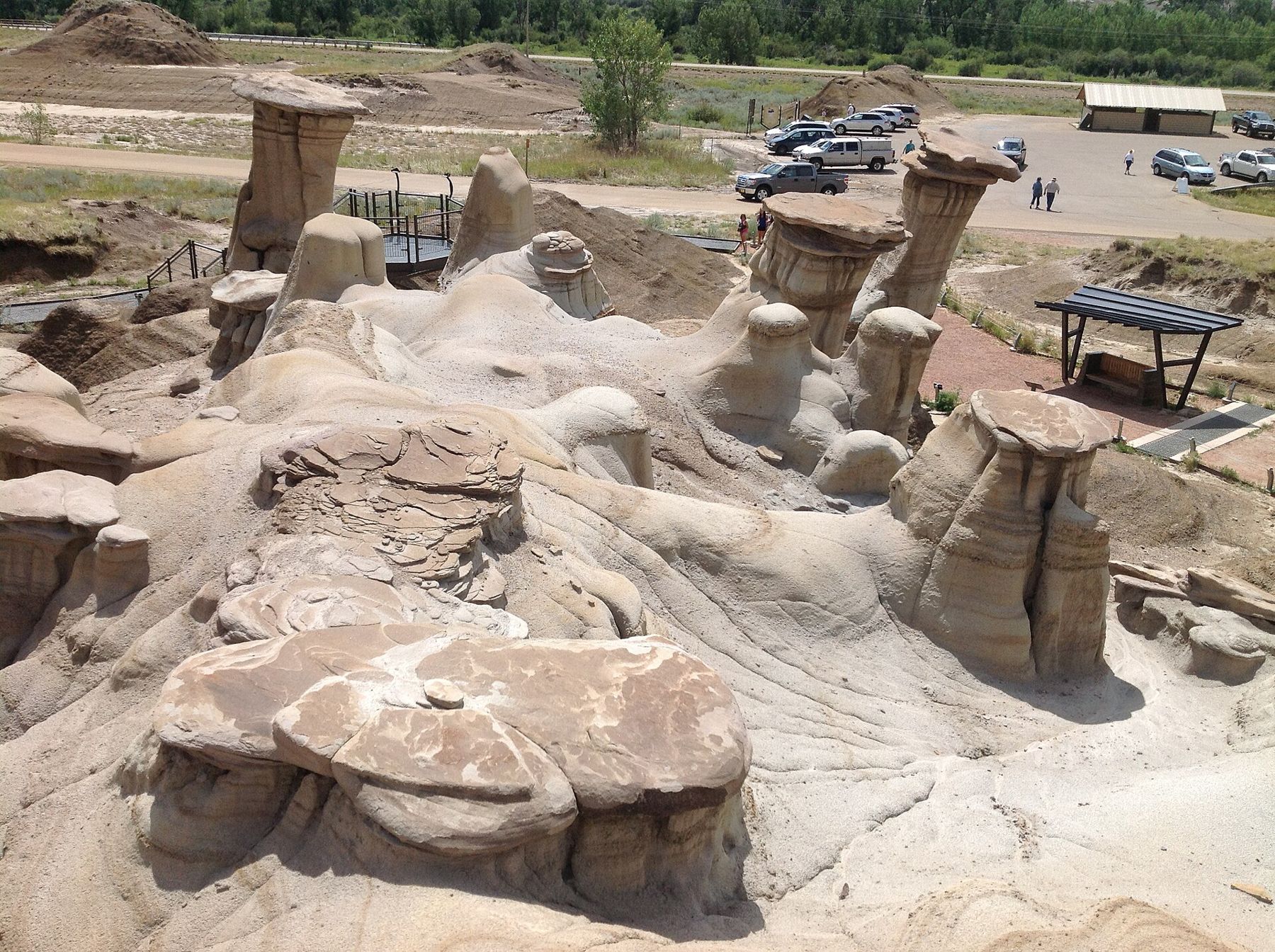
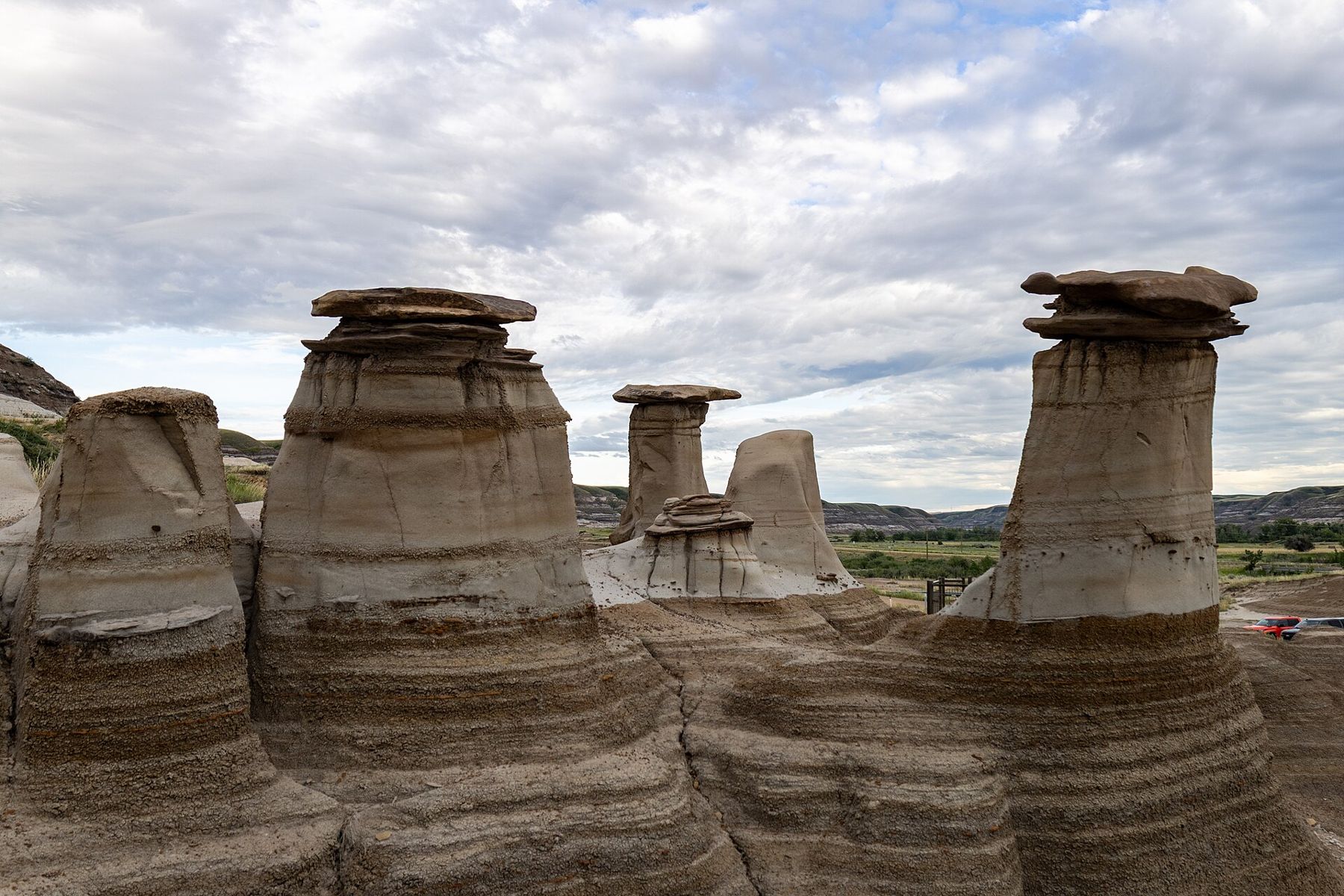
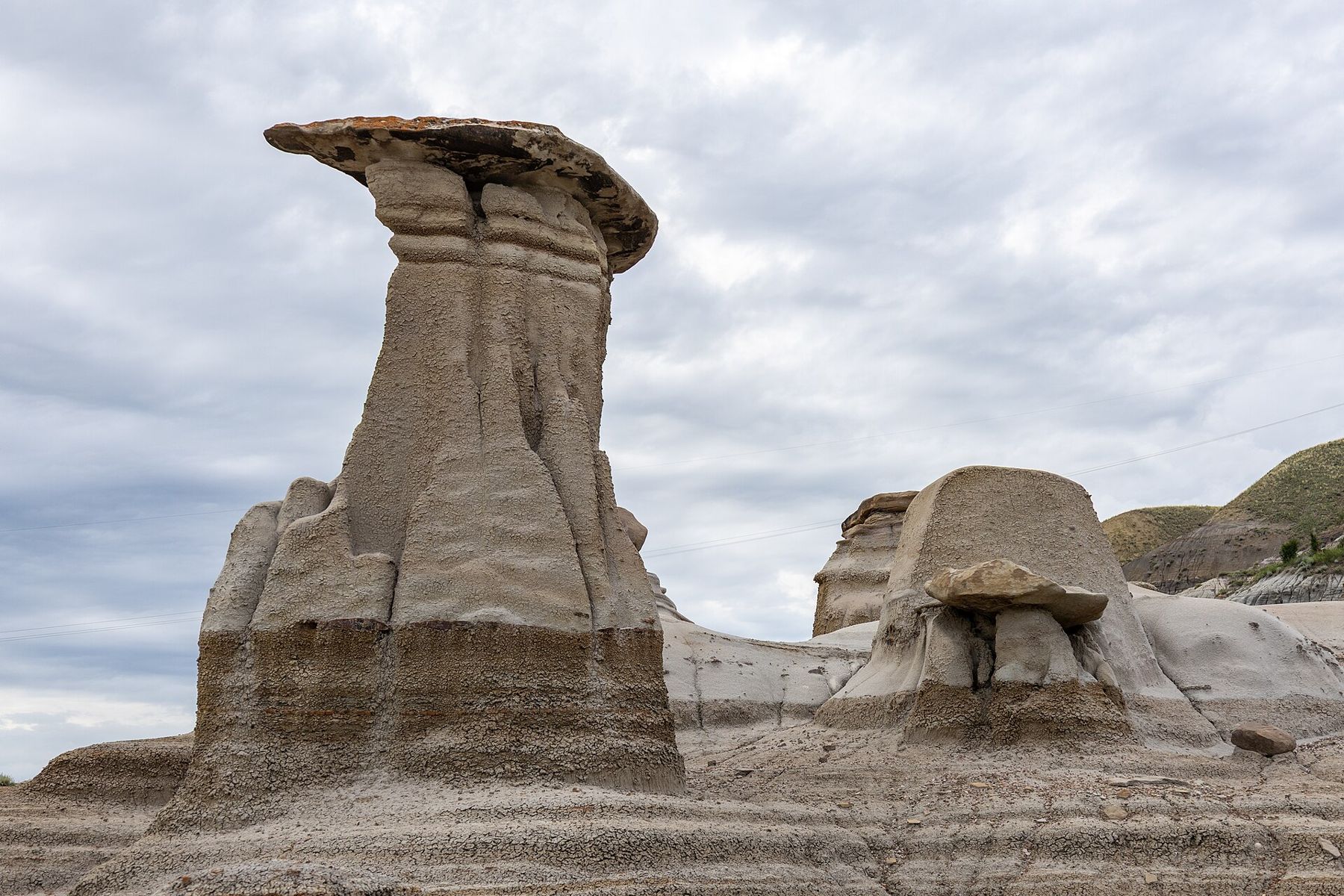
Southeast of town, on Highway 10 between Rosedale and East Coulee, the Hoodoos trail leads among clusters of slender stone columns topped by flat, harder caps. The caps protect the softer sandstone and mudstone beneath. When a cap falls, the column below wears away far faster. Boardwalks and stairs lead you close, and signs ask you not to climb the hoodoos, which are fragile.
Horseshoe Canyon lies southwest of Drumheller on Highway 9, on the way in from Calgary.  Another trek · Northern RockiesHell Creek, where Tyrannosaurus rex was first found From the prairie edge, the ground falls suddenly into a broad, curving canyon of striped badlands. Viewpoints sit close to the parking area, and paths drop into the canyon for those who want to walk among the ridges. The dark bands in the walls are coal seams within the Horseshoe Canyon Formation, a rock unit that also holds dinosaur fossils.
That rock tells its own story. The Horseshoe Canyon Formation was laid down on a coastal plain near the end of the Cretaceous, when swamps near the edge of an inland sea built up the plant matter that later became coal. Dinosaurs walked through those swamps, and their bones lie in the same layers as the coal seams that once fed the valley's mines.
Dinosaurs in town and the Red Deer valley
Drumheller has embraced its fame. Painted fiberglass dinosaurs stand on street corners all over town, and beside the visitor information center rises a giant model Tyrannosaurus rex with a viewing platform in its mouth. Children love hunting for the statues, and it is a light way to spend an hour between more serious outings.
Many of the street dinosaurs are painted in bright, playful colors rather than in any attempt at accuracy, which makes a useful talking point. Ask children which features scientists actually know, such as size and shape, and which they can only guess, such as color.
The valley itself rewards a drive. The North Dinosaur Trail runs northwest from town past Horsethief Canyon, another viewpoint over the badlands, to a small cable ferry that crosses the Red Deer River in summer. The South Dinosaur Trail returns along the other bank. Southeast of town, the road toward East Coulee passes old mining sites, a reminder that this valley was once one of Alberta's coal centers.
Planning your visit
From Calgary, the usual route runs northeast on Highway 9 through farm country, dropping into the valley past Horseshoe Canyon. The museum sits a few kilometers northwest of downtown Drumheller, off the North Dinosaur Trail. Summer is busiest, with all programs running; spring and early autumn are calmer and cooler. Winter visits work well for the museum alone, though trails can be icy.
Drumheller has fuel, groceries, campgrounds and places to stay, so it makes an easy base. Book ahead for summer weekends and long holidays, when the town fills with families. In spring and autumn, mornings in the valley can be cool even when afternoons are warm, so pack a light layer.
Plan at least half a day for the museum, and another half day or more for the Hoodoos, Horseshoe Canyon and the valley drive. Summer heat in the valley can be intense, so carry water on any walk. If you have more time, continue southeast to Dinosaur Provincial Park, one of the richest bonebed areas on Earth, or cross into Montana for the Museum of the Rockies on a longer loop through dinosaur country.
The photographs on this trek were shared under open licences; their photographers are named in Who shot the bones.