
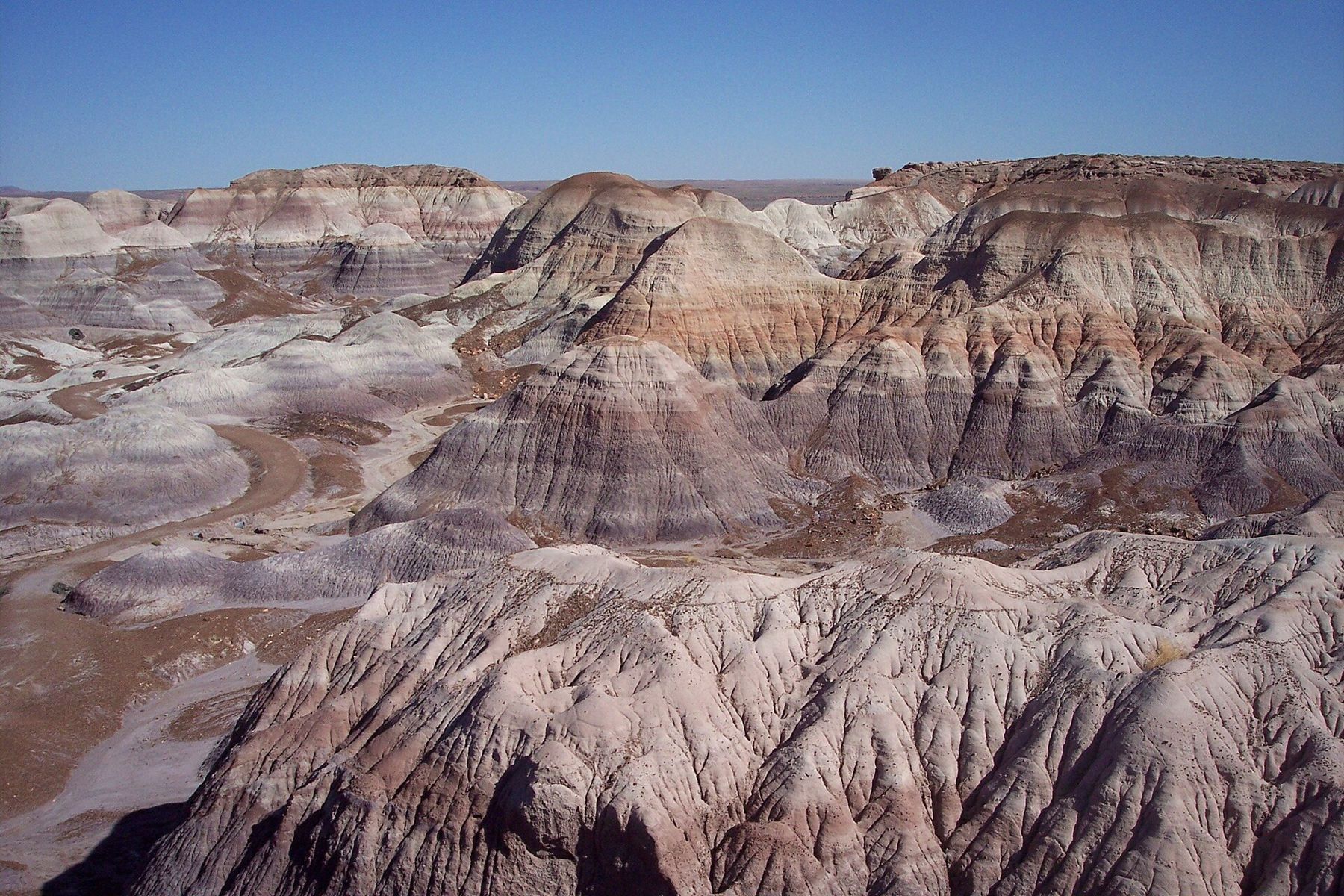
In northeastern Arizona, the high desert breaks into hills of red, purple, gray and blue clay, scattered with stone logs that were living trees more than 200 million years ago. Petrified Forest National Park protects one of the largest concentrations of petrified wood on Earth, along with the colorful badlands of the Painted Desert and a rich record of life from the Late Triassic, when the first dinosaurs were just appearing.
A single paved road runs through the park from north to south, about 28 miles long, linking viewpoints, short trails and visitor centers at both ends. You can see the highlights in a day, but the park repays a slower visit with time on foot among the badlands.
How wood turned to stone
The logs come from tall conifer trees that grew on a Triassic landscape crossed by rivers. When they fell, floods washed many of them into channels and buried them in sediment rich in volcanic ash. Groundwater carrying silica from that ash seeped into the wood and slowly replaced it with quartz. Traces of iron, manganese and other minerals added the reds, yellows, purples and blacks.
The result is wood that has become stone so completely that many logs have broken into short, neat sections, as if sawn. Many still show bark and growth rings. Because quartz is hard, the logs outlast the softer clay around them, and erosion keeps uncovering more of them.
Not every log is a whole trunk. Many are segments, broken roots or branches, mixed with smaller chips that weathered off over time. Look for knots where branches once grew, and for places where the stone keeps the texture of wood so faithfully that it seems it should feel warm.
The Painted Desert and Blue Mesa
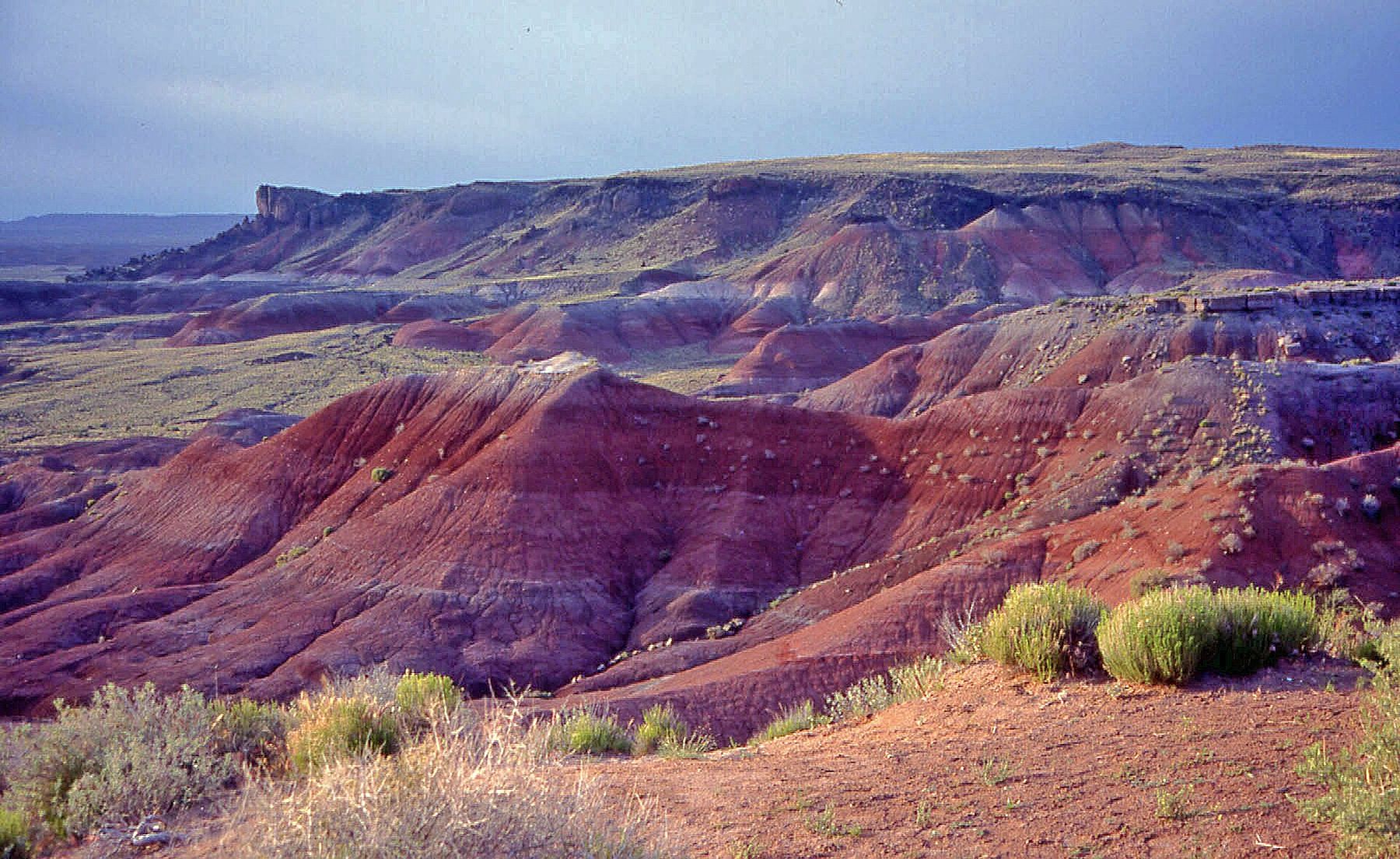
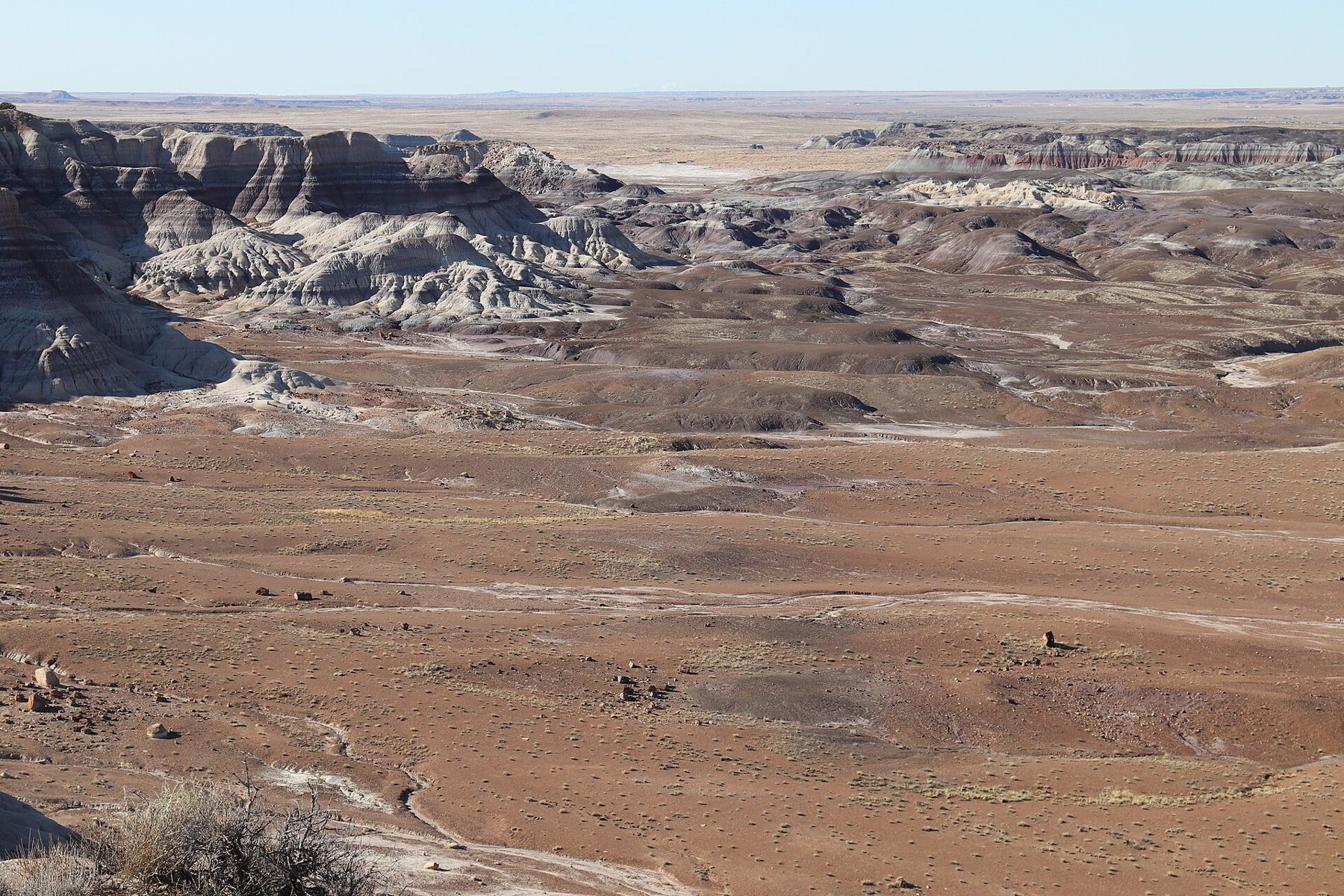
The northern part of the park overlooks the Painted Desert, a sweep of banded badlands that changes color with the light. Viewpoints along the rim, such as Tawa Point, look out over red and pink hills. The Painted Desert Inn, a historic adobe-style building on the rim, now serves as a museum, with painted murals inside.
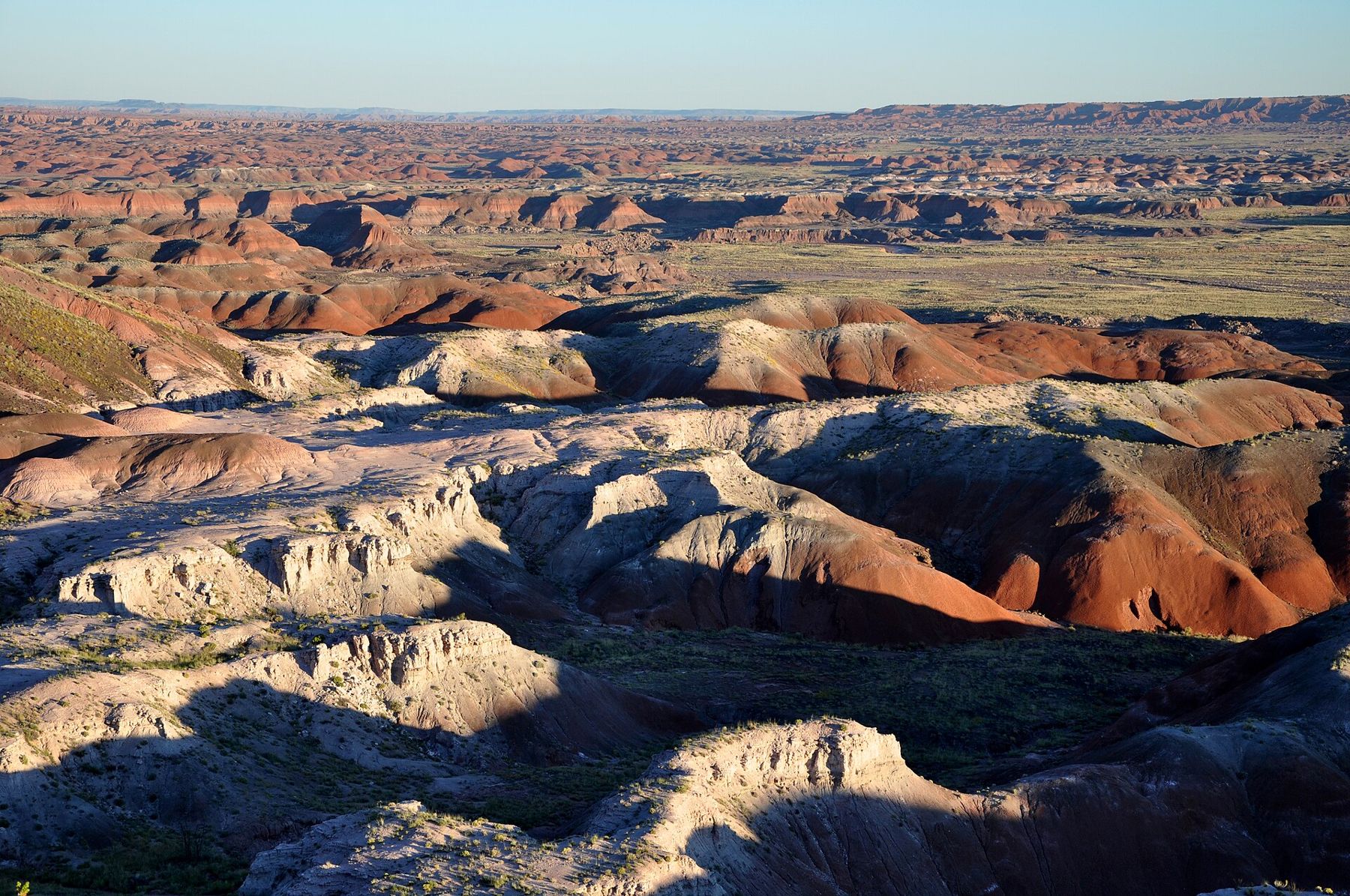
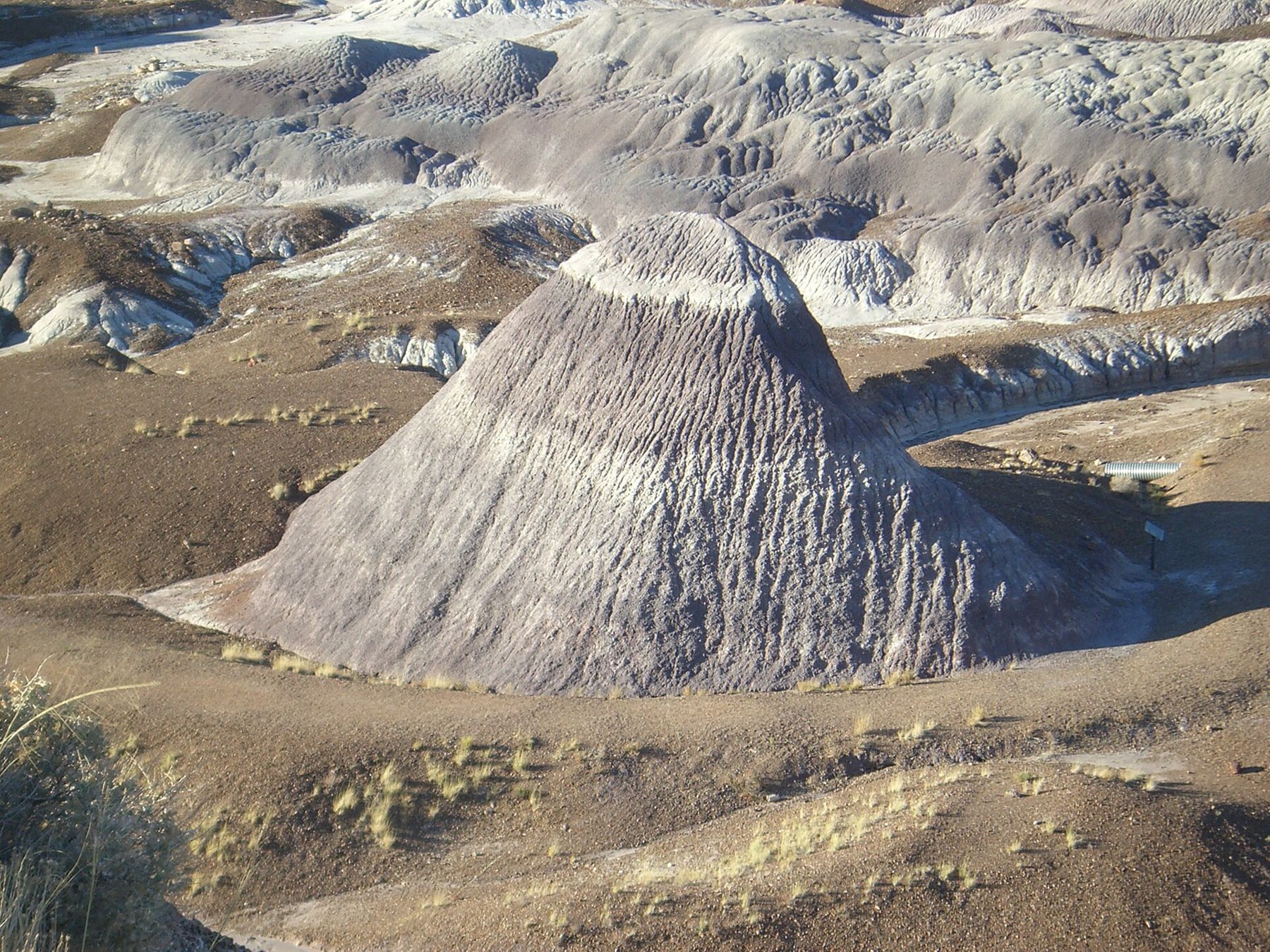
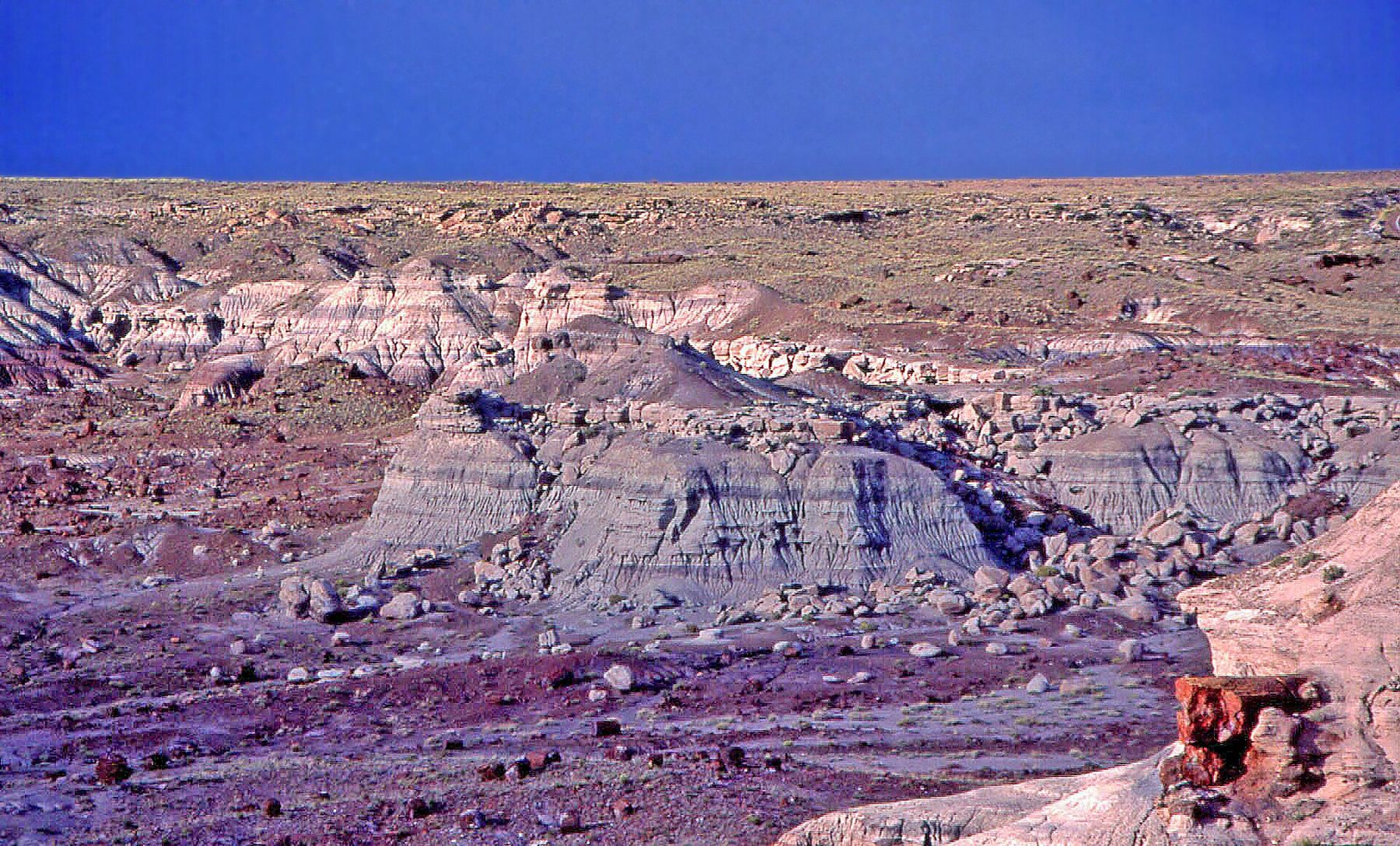
Farther south, the Blue Mesa road leads to a loop trail that drops into hills of bluish, gray and purple clay, striped like a layer cake. These are mudstones of the Chinle Formation, rich in clay that swells when wet and shrinks when dry, leaving a crackled surface. Petrified logs lie on and among the hills, some perched on pedestals of softer rock.
Triassic reptiles and early dinosaurs
The forest was home to animals that look strange today. Phytosaurs, long-snouted reptiles that resembled crocodiles, hunted in the rivers. Aetosaurs, plant-eaters covered in bony armor, browsed the banks. Big flat-headed amphibians called metoposaurs lived in the water, and large predators on the crocodile side of the reptile family ruled the land.
Dinosaurs were present but rare and mostly small. Fossils of early dinosaurs and their close relatives have been found in the park, including the predator Chindesaurus. Paleontologists continue to work in the park, and the Rainbow Forest Museum near the south entrance shows skeletons and casts of these animals. 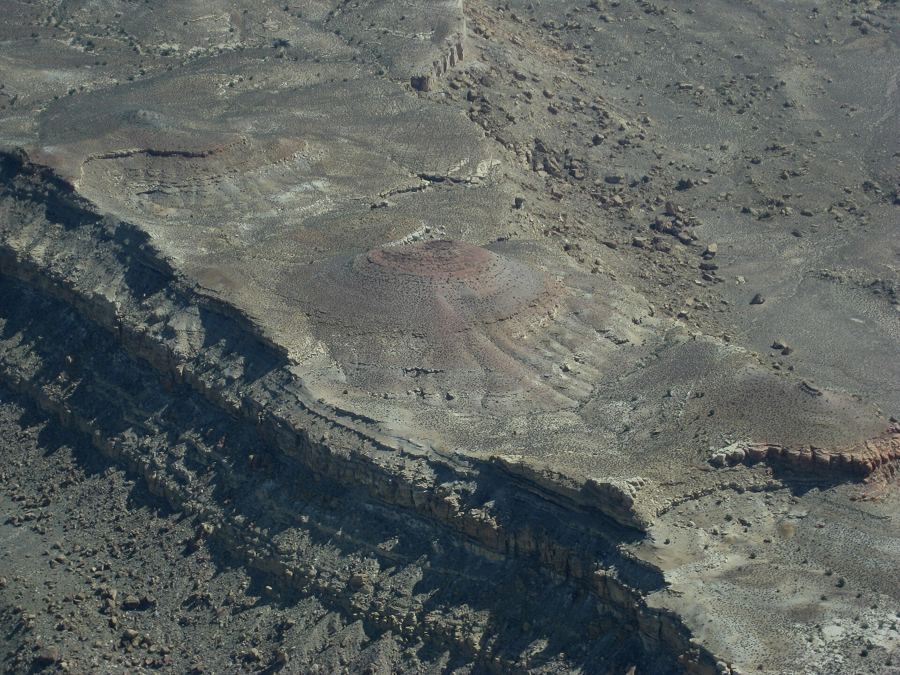 Another trek · SouthwestGrand Staircase-Escalante's new dinosaurs The same Chinle rocks run east into New Mexico, where Ghost Ranch yielded hundreds of skeletons of the early dinosaur Coelophysis, and rocks of similar age in Argentina at Ischigualasto hold some of the oldest dinosaurs known.
Plants tell part of the story too. Beyond the big conifers, the rocks hold ferns, horsetails, cycad relatives and other plants, along with fossil pollen that helps researchers reconstruct the climate. The picture is of a warm, seasonally wet land near the equator, part of the supercontinent Pangaea, far from where Arizona sits today.
Walking among the logs
The southern part of the park holds the densest log fields. Behind the Rainbow Forest Museum, the short Giant Logs trail loops among some of the largest logs in the park, and the nearby Long Logs trail leads to a tangle of logs that probably piled up in an ancient logjam. A side path reaches Agate House, a small pueblo that people built from blocks of petrified wood centuries ago, now partly reconstructed.
Farther north, Crystal Forest shows logs whose cracks and hollows hold clear quartz and purple amethyst crystals, and Jasper Forest overlooks a valley floor scattered with log sections. Paved paths keep you off the fragile ground. Some areas of the park are open to walking off trail; ask at a visitor center about current rules and permits before you head out.
Why you must not take the wood
Taking petrified wood from the park is against the law, even a small chip. The rule exists because people carried away huge amounts of it before the area was protected as a national monument in 1906, and it became a national park in 1962. Even now, small thefts by many visitors add up, and the landscape changes when they do.
Over the years, many visitors have mailed pieces back to the park, often with letters of apology, some claiming the stone brought them bad luck. Whatever you make of the curse, the simpler point stands: the wood belongs where it fell, where everyone after you can see it. Leave rocks, bones, plants and archaeological objects untouched, and read the rules for finding fossils before visiting other public lands.
Whatever you make of the curse, the simpler point stands: the wood belongs where it fell, where everyone after you can see it.
Route 66 and planning a visit
The park is the only national park that preserves a stretch of the old Route 66 alignment. Near the northern end, an old car sits beside the line where the highway once crossed, close to the modern Interstate 40. Petroglyphs at Newspaper Rock and the ruins of Puerco Pueblo tell the story of people who lived here many centuries ago.
The north entrance sits off Interstate 40; the south entrance is on US Highway 180, near the town of Holbrook. Many travelers drive through in one direction and rejoin the interstate. An entrance fee applies, and the park road has set opening hours that change with the seasons, so check before you go. Spring and autumn bring the mildest weather; summer is hot, with afternoon storms, and winter can bring snow. Carry water on every trail, as shade is almost nonexistent.
With children, the Junior Ranger program, the museum skeletons and the short paved trails make an easy day. Older visitors may want to time a Painted Desert overlook for early or late in the day, within the park's opening hours, when low light brings out the full range of colors in the hills.
The photographs on this trek were shared under open licences; their photographers are named in Who shot the bones.