
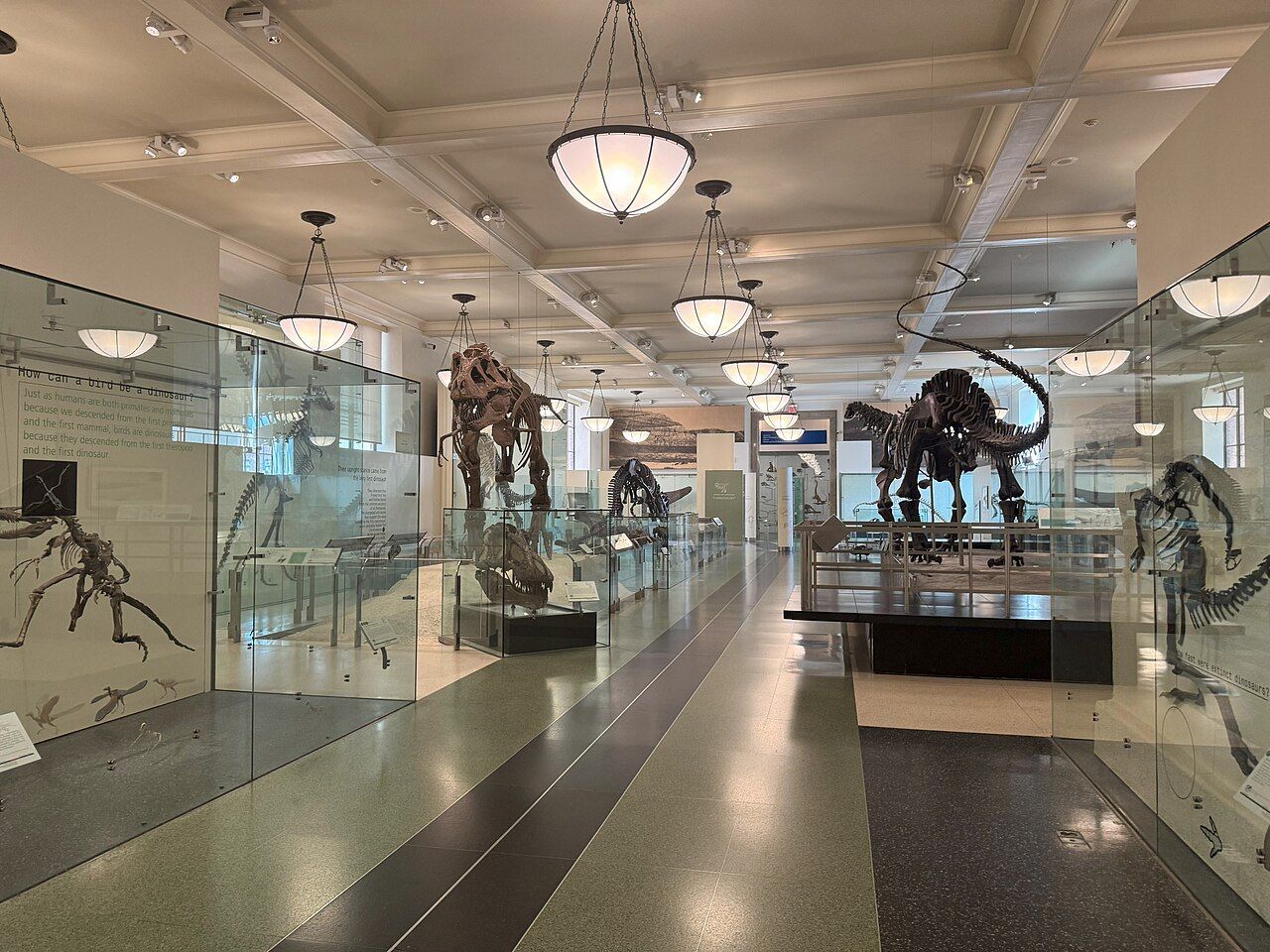
The American Museum of Natural History on Central Park West holds one of the world's great collections of fossil vertebrates. Much of it was gathered more than a century ago by expeditions that crossed the American West, Canada and the Gobi Desert. The best of it is on the fourth floor, in a set of connected halls that tell the history of backboned animals as a family tree.
A floor laid out as a family tree
The fossil halls were rebuilt in the 1990s around one idea. Instead of grouping animals by size or age, they follow evolutionary relationships. A path runs through the floor like the trunk of a tree. Where the path branches, an alcove explains the new feature that sets one group apart, such as a hole in the hip socket for dinosaurs, or grasping hands for a group of meat-eaters.
Start in the orientation centre, then walk through the halls in order: early vertebrates, then the two dinosaur halls, then the mammals. Read the branch points and the floor makes sense. Skip them and it is still a stunning room full of skeletons. Either way works.
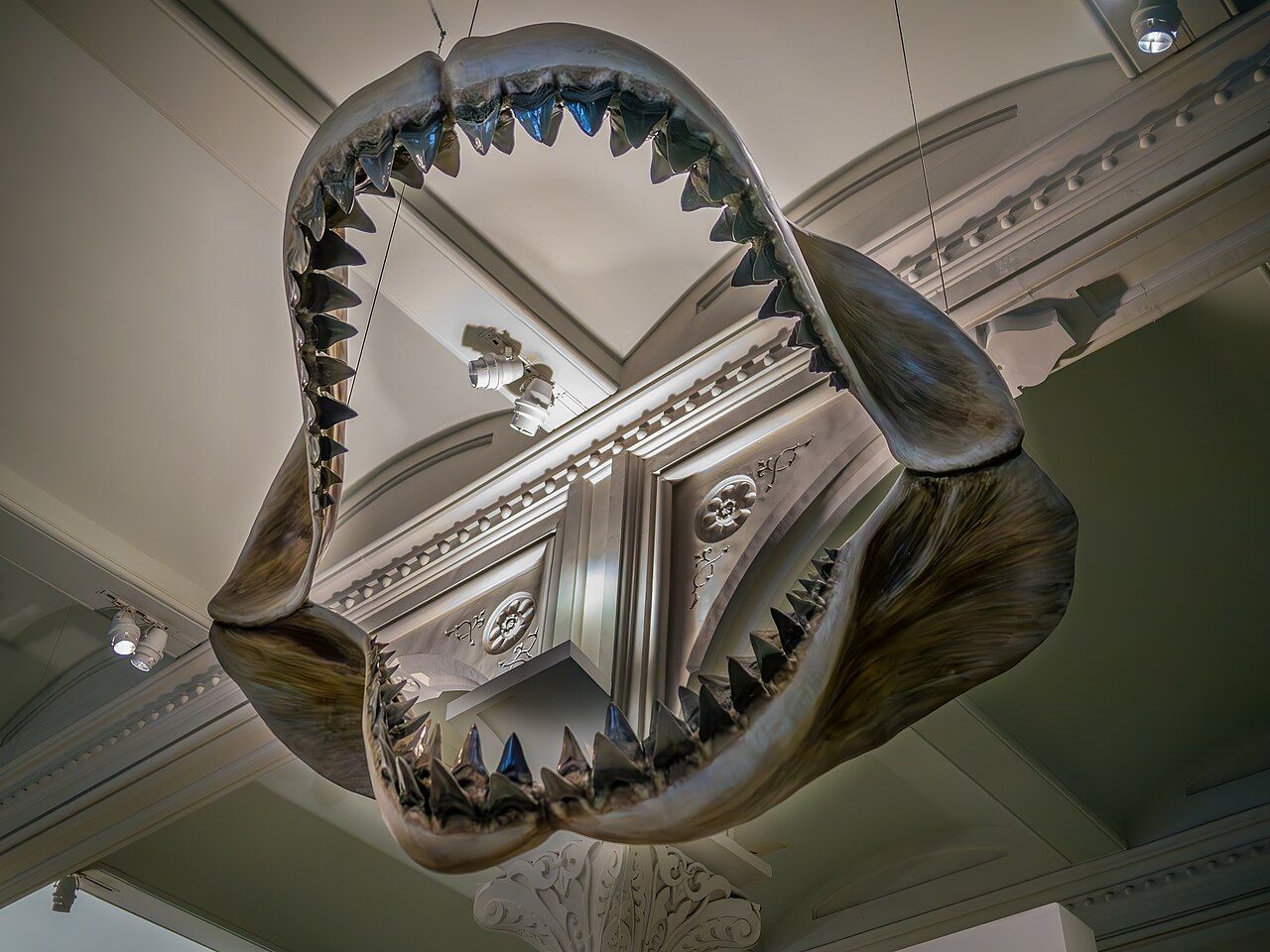
The hall of early vertebrates comes first, with armoured fish, sharks and the animals that first crawled onto land. The reconstructed jaws of a megalodon, the giant extinct shark, hang overhead. Children can stand beneath them and see how the teeth are set in rows.
Barnum Brown's T. rex
The Hall of Saurischian Dinosaurs holds the museum's most famous skeleton: a Tyrannosaurus rex collected by Barnum Brown in Montana in 1908. Brown found the first known T. rex skeleton in 1902, in the Hell Creek badlands. The 1908 find was better preserved, especially the skull, and it became the model for how the animal was shown for most of the twentieth century.
For decades it stood upright, tail on the ground, like a giant kangaroo. When the hall was rebuilt, the skeleton was remounted in a horizontal pose, head forward and tail held out behind for balance, the way scientists now think the animal stood. Nearby stand the long-necked Apatosaurus and other saurischians, the group that also includes the ancestors of birds.
The museum once owned both skeletons. During the Second World War, worried that a single bombing raid could destroy both, it sold the 1902 specimen, the original type of the species, to the Carnegie Museum in Pittsburgh, where it still stands. The New York skeleton you see today is the 1908 animal, with some missing pieces filled in. Barnum Brown went on collecting for decades, and many of the skeletons on this floor passed through his hands. The museum's archive photographs of his camps, horses and plaster jackets help explain how much labour stands behind each mount.
Walk around the T. rex rather than stopping in front of it. From the side you see how short the body is for such a large head, and from behind you see how narrow the hips are.
The ornithischians and the duck-bills
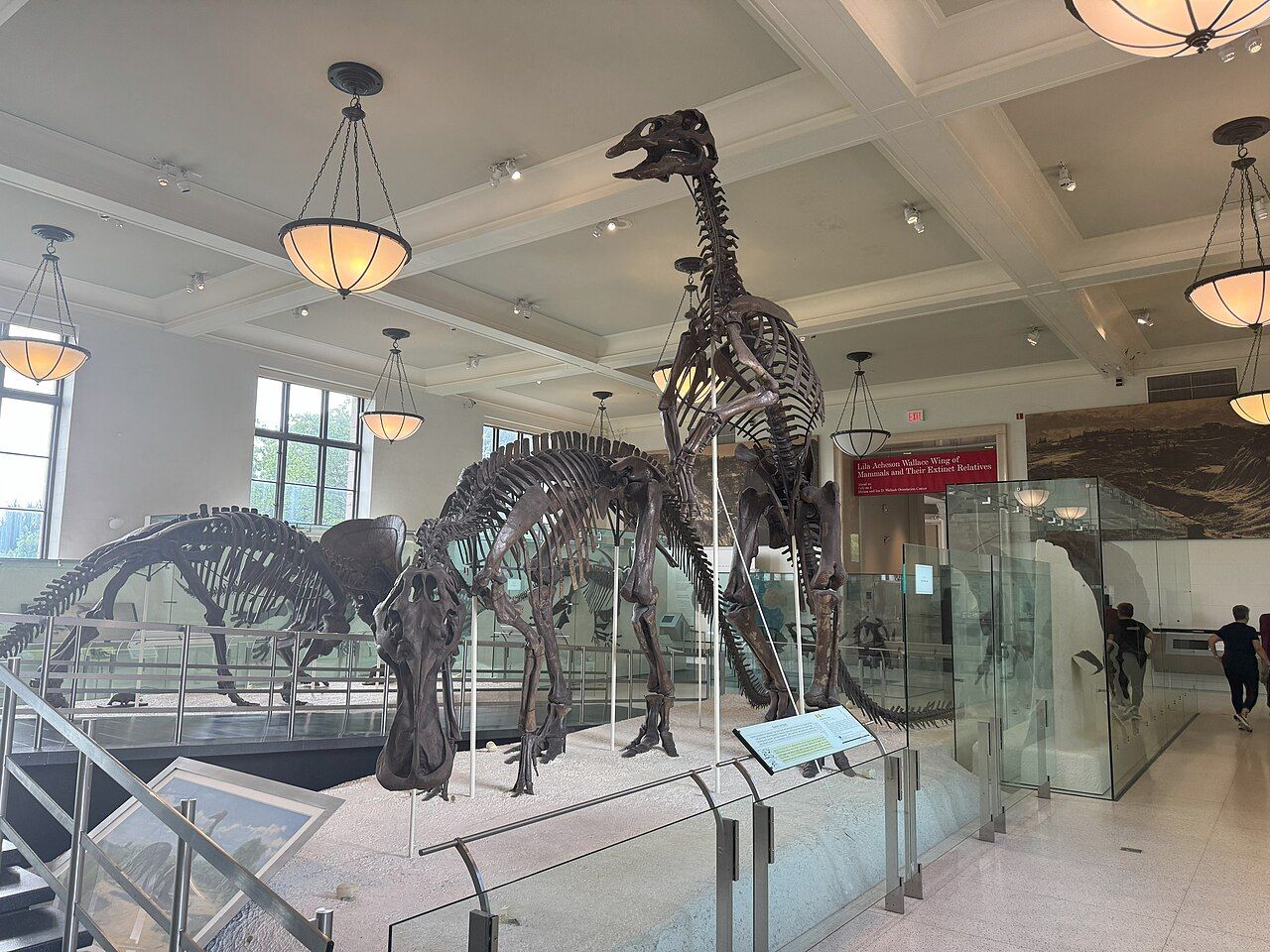
The Hall of Ornithischian Dinosaurs holds the plant-eaters with bird-like hips: horned dinosaurs such as Triceratops, armoured dinosaurs, and the duck-billed hadrosaurs. Many came from the fossil fields of Alberta and Montana. Look for the mummified duck-bill, a skeleton with impressions of its skin, and compare it with the bones in the Royal Tyrrell Museum if you travel north.
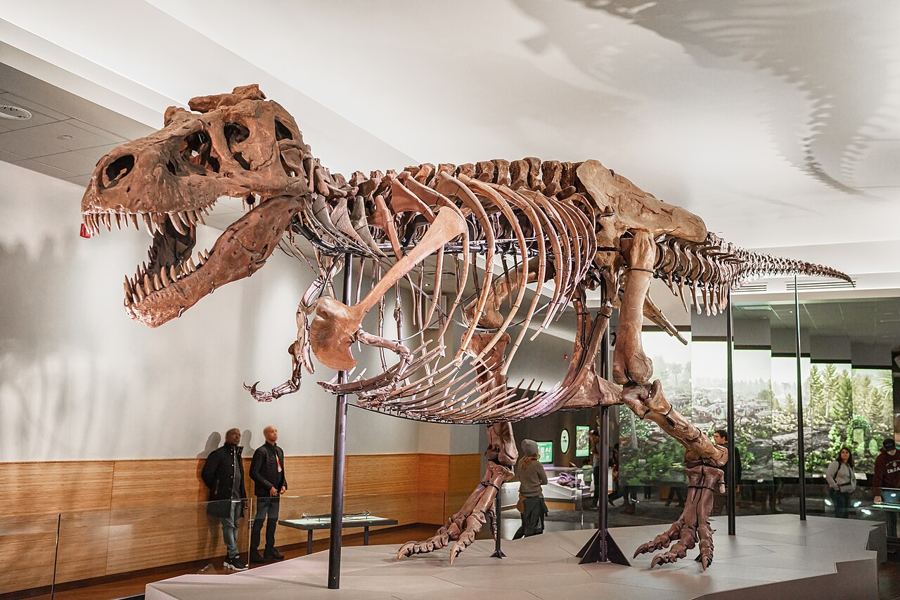 Another trek · Fossil hallsSue at the Field Museum
These halls also hold eggs, nests and small dinosaurs from Mongolia, collected by the museum's Central Asiatic Expeditions in the 1920s. That story belongs to the Flaming Cliffs of the Gobi, and the specimens here are the reason the name of those cliffs is known around the world.
The Barosaurus and the titanosaur
Two giants frame the visit. On the second floor, in the rotunda by the Central Park West entrance, a mother Barosaurus rears up on her hind legs to protect her young from an attacking Allosaurus. These are casts, not bone, but the scene is one of the most photographed in the city and makes a fine first look before you climb to the fourth floor.
On the fourth floor, a cast of a titanosaur, Patagotitan, fills a whole room. The animal was found in Argentina and described in 2017. It is so long that its head reaches out of the gallery toward the lifts. Stand under the neck and look up; the size makes more sense here than in any number.
Pacing a visit
The museum is big, and it is easy to spend the morning on the ground floor and reach the dinosaurs tired. Go to the fourth floor first. Allow at least two hours for the fossil halls alone, more with children who want to read and draw.
- Tickets: admission rules differ for local residents and other visitors, and special exhibitions cost extra. Check before you go.
- Getting there: the B and C subway trains stop at 81st Street under the museum.
- Crowds: weekday mornings outside school holidays are calmest; winter weekends are busiest.
- Breaks: Central Park is across the street for a picnic between halls.
Making it part of a bigger trip
Much of what you see on the fourth floor came out of the American West. After New York, the badlands of Montana, Wyoming and Alberta stop being far-off places and become the source of skeletons you have already met. That is the best reason to start here: you learn the names, the families and the questions, and then you go and stand in the rocks they came from.
The photographs on this trek were shared under open licences; their photographers are named in Who shot the bones.